

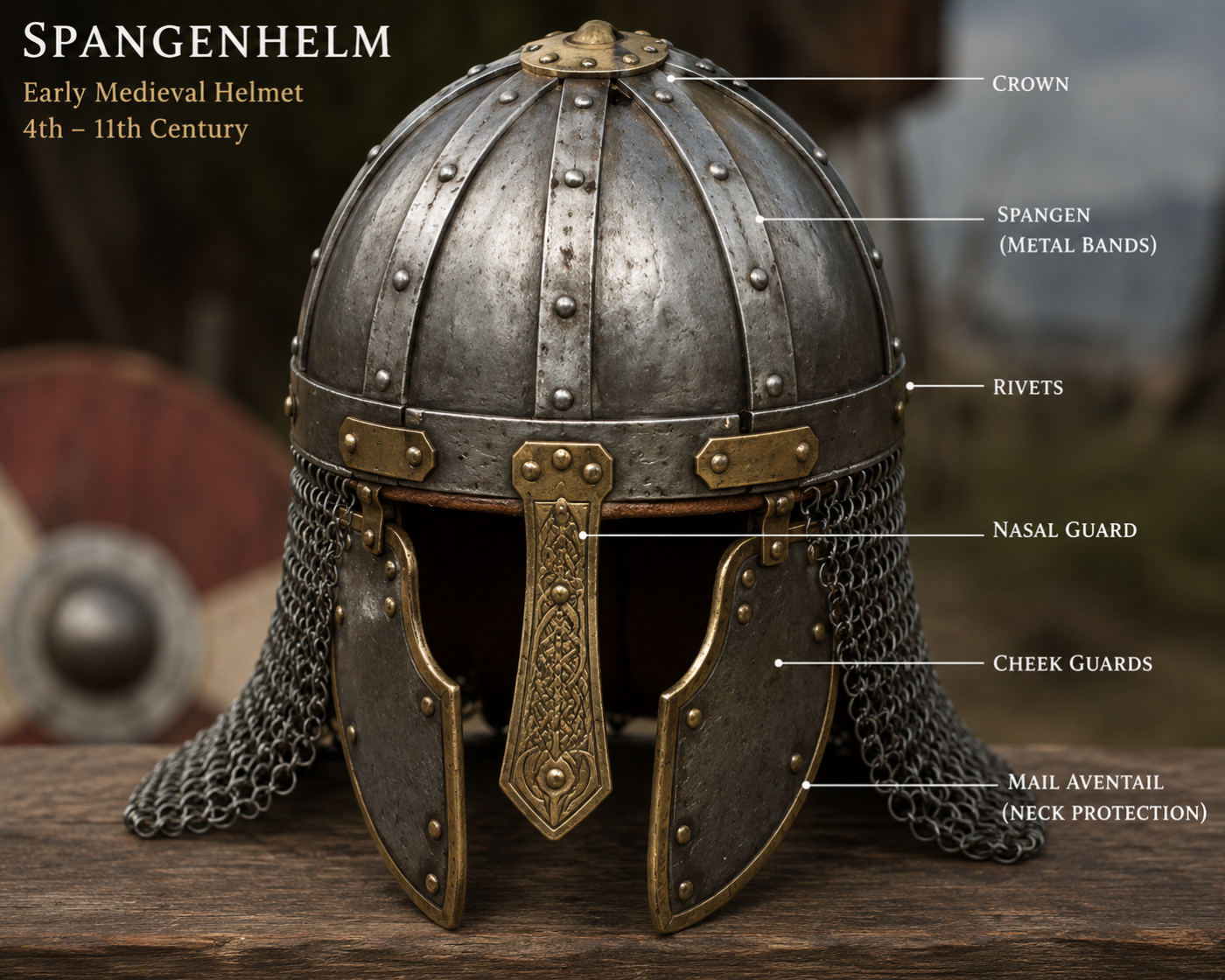

The spangenhelm is one of the most recognizable helmets from the early medieval period. Known for its practical construction and distinctive appearance, it protected countless warriors across Europe, the Middle East, and parts of Asia for several centuries. Unlike helmets forged from a single sheet of metal, this design used a framework of metal bands that held several plates together. This clever method made production easier while maintaining excellent durability.
Today, historians, archaeologists, collectors, and historical reenactors continue to study the spangenhelm because it represents an important stage in the evolution of military equipment. Its influence can still be seen in museum collections and modern reconstructions. Understanding this helmet provides valuable insight into medieval warfare, craftsmanship, and cultural exchange.
What Is a Spangenhelm?
A spangenhelm is a type of combat helmet built using multiple metal plates connected by a framework called “spangen,” which are narrow metal strips forming the helmet’s structure. Rather than shaping a single large piece of steel, armorers assembled several smaller pieces into one protective helmet.
This method offered several practical advantages. It reduced manufacturing complexity, allowed damaged sections to be repaired individually, and made efficient use of available materials. Because of these benefits, the design spread widely throughout different civilizations.
Most examples feature a rounded or conical shape with additional protective elements such as cheek guards, nose guards, and chainmail neck protection.
Origins of the Spangenhelm
The earliest examples appeared during the Late Roman period, around the fourth century. Historians believe the concept originated in Central Asia or regions influenced by Persian military traditions before spreading westward into Europe.
As trade routes expanded and armies encountered one another, military technology evolved through cultural exchange. The spangenhelm became particularly popular among Germanic tribes, Byzantine soldiers, Lombards, Franks, Goths, and early medieval kingdoms.
Archaeological discoveries across Europe reveal numerous variations, demonstrating how different cultures adapted the design to suit their own fighting styles and available resources.
Early Military Influence
The decline of the Western Roman Empire accelerated the spread of practical armor designs. As centralized manufacturing decreased, helmets that could be assembled from multiple components became increasingly attractive.
Warriors valued equipment that balanced protection with affordability. The spangenhelm met both needs, making it a common choice for professional soldiers and wealthy nobles alike.
Key Design Features
Although many regional variations existed, most spangenhelms shared several defining characteristics.
Multi-Plate Construction
Instead of using one continuous shell, craftsmen joined several iron or steel plates with metal bands. This framework distributed impact while simplifying production.
Nasal Guard
Many surviving examples include a vertical nose guard that protected the face without significantly reducing visibility. This feature became one of the helmet’s most recognizable elements.
Conical Shape
The pointed or rounded crown helped deflect downward weapon strikes. Rather than absorbing the full force directly, the angled surface encouraged blows to glance away.
Chainmail Aventail
Some helmets incorporated a mail aventail, which protected the neck, shoulders, and lower face. This additional defense improved survival against slashing attacks.
Decorative Elements
High-status warriors often commissioned elaborate versions featuring bronze fittings, engraved patterns, silver inlays, or gilded ornamentation. These decorative details reflected wealth and social standing as much as battlefield function.
Materials Used in Construction
Most spangenhelms combined iron with steel components. The framework usually consisted of strong iron bands, while individual plates varied depending on local metallurgy.
Leather straps secured the internal padding, creating a more comfortable fit during extended campaigns. Wealthier owners sometimes added precious metals or intricate decorative work, turning the helmet into both protective equipment and a symbol of prestige.
The combination of practical engineering and artistic craftsmanship explains why so many examples remain fascinating historical artifacts.
Why the Spangenhelm Became Popular
Several factors contributed to the widespread adoption of this helmet throughout early medieval Europe.
First, manufacturing required smaller metal pieces, making production more practical for regional armorers. Second, repairs were easier because damaged plates could often be replaced individually instead of rebuilding the entire helmet.
Another advantage involved flexibility. Armorers could adjust the number, size, and arrangement of plates while maintaining the same overall structure. This allowed local craftsmen to customize designs according to available materials and military needs.
Its balance between protection, durability, and cost made it one of the most successful helmet designs of its era.
Who Wore the Spangenhelm?
The helmet appeared across a remarkable variety of cultures and military organizations.
Germanic warriors frequently wore versions featuring nasal guards and decorative bronze fittings. Byzantine soldiers adapted similar designs for imperial armies, while Lombards, Ostrogoths, Visigoths, and Franks incorporated regional variations.
Even mounted cavalry units appreciated the helmet because its relatively light construction offered effective protection without severely restricting movement.
Elite nobles generally owned more ornate examples, whereas ordinary professional soldiers often used simpler versions focused primarily on functionality.
Spangenhelm in Medieval Warfare
Battlefields during the early medieval period presented numerous dangers, including swords, axes, spears, arrows, and blunt-force weapons.
The spangenhelm helped reduce injuries by protecting the skull while allowing reasonable visibility and hearing. Although no helmet could guarantee complete safety, its conical shape and reinforced framework improved defensive performance against many common attacks.
The addition of cheek guards and chainmail further increased protection during close combat.
Because battles frequently involved prolonged engagements, comfort also mattered. Internal padding absorbed some impact while improving wearability over extended periods.
Archaeological Discoveries
Excavations throughout Europe have uncovered numerous surviving examples of spangenhelms. These discoveries help researchers understand historical manufacturing techniques and military equipment.
Many helmets recovered from graves, battlefields, and settlements reveal subtle regional differences in plate arrangement, decorative style, and construction quality.
Corrosion has affected many artifacts, but modern conservation techniques allow museums to preserve and study these important pieces of history.
Each discovery contributes valuable information about trade, craftsmanship, and military organization during the early Middle Ages.
Differences Between a Spangenhelm and Other Medieval Helmets
The spangenhelm differs significantly from later medieval helmets.
Earlier designs emphasized modular construction using multiple joined plates. Later helmets increasingly relied on forging larger single-piece steel shells as metallurgy improved.
For example, the nasal helmet evolved into stronger one-piece constructions, while later great helms offered more comprehensive facial protection for heavily armored knights.
These developments reflected advances in metalworking technology rather than shortcomings in the earlier design.
Modern Interest in the Spangenhelm
Today, the spangenhelm remains highly respected among historians and historical enthusiasts.
Museum exhibitions regularly display surviving examples to illustrate medieval craftsmanship. Historical reenactment groups commission accurate reproductions using traditional techniques, allowing participants to experience authentic equipment.
Collectors also value well-crafted replicas because they combine historical accuracy with impressive visual appeal.
Academic research continues examining archaeological finds to better understand regional manufacturing traditions and military evolution.
Caring for a Reproduction Spangenhelm
Individuals who own reproduction helmets should maintain them carefully to preserve both appearance and functionality.
After use, the helmet should be cleaned to remove moisture, dirt, and sweat. Applying protective oil helps prevent rust on steel surfaces. Leather components benefit from occasional conditioning to prevent drying or cracking.
Proper storage in a cool, dry environment significantly extends the lifespan of the reproduction while preserving its finish.
Routine maintenance ensures that reenactors and collectors can enjoy their equipment for many years.
Interesting Facts About the Spangenhelm
Several fascinating facts highlight the importance of this historical helmet.
Many surviving examples are over 1,400 years old, demonstrating remarkable durability. The construction method allowed damaged plates to be replaced without rebuilding the entire helmet. Archaeologists have found examples across Europe, North Africa, and Western Asia, illustrating the design’s extraordinary geographic reach.
Its widespread adoption reflects centuries of military innovation and cultural interaction among diverse civilizations.
Conclusion
The spangenhelm stands as one of the most influential helmet designs of the early medieval world. Its ingenious framework of metal bands and individual plates offered a practical solution to the manufacturing challenges of its time while delivering dependable battlefield protection.
Although later advances in metallurgy eventually led to one-piece steel helmets, the spangenhelm played a critical role in military history for centuries. Today, it remains a favorite subject for historians, archaeologists, museum visitors, collectors, and reenactors who appreciate its combination of engineering, craftsmanship, and historical significance.
Studying the spangenhelm not only reveals how ancient armor evolved but also provides a deeper understanding of the societies that created and relied upon this remarkable piece of protective equipment.









Leave a Comment