

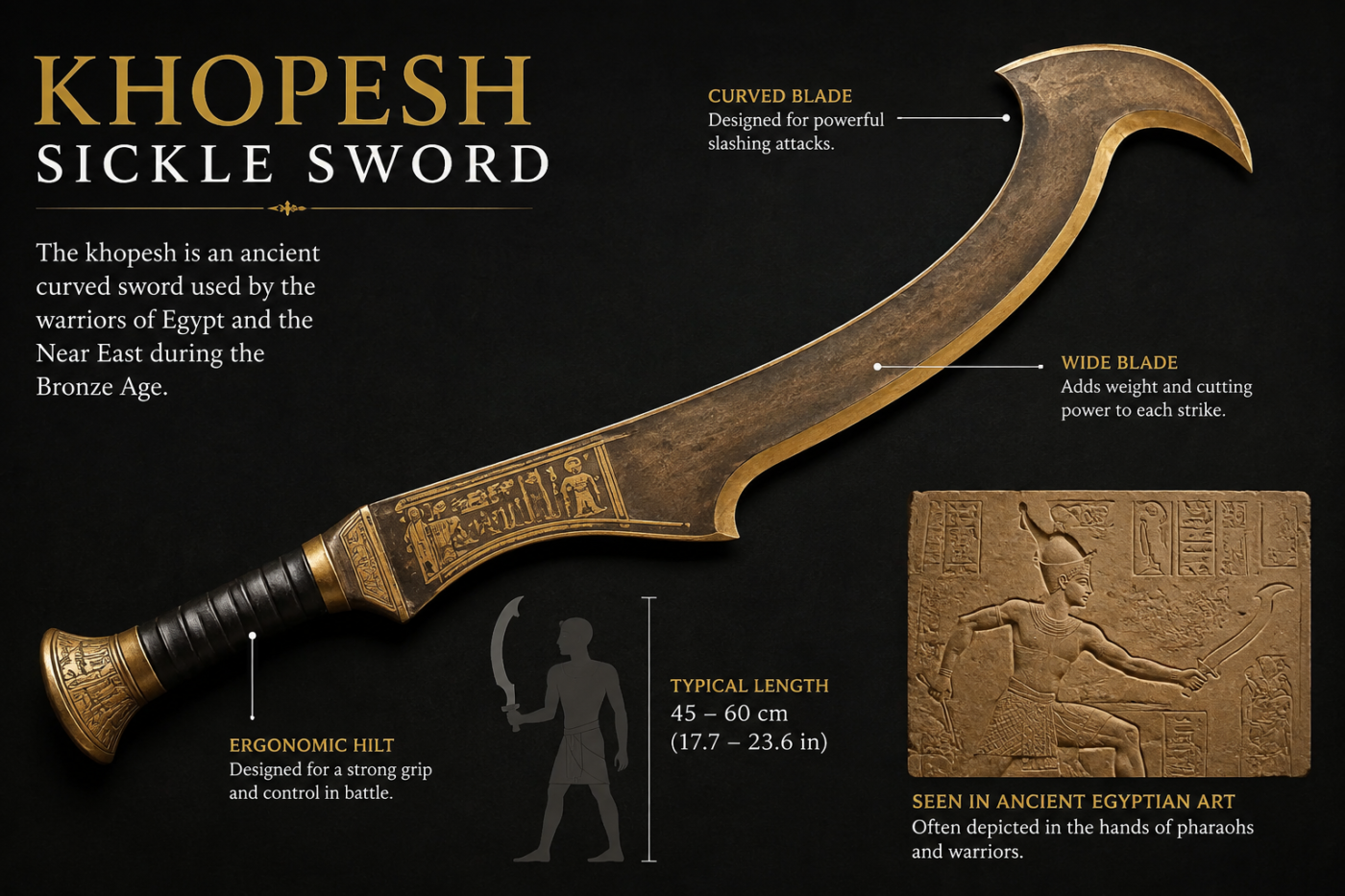

The khopesh sickle sword is one of the most recognizable weapons associated with the ancient Near East and Egypt. Its unusual curved blade immediately separates it from the straight swords that dominate popular images of ancient warfare. More than a simple cutting weapon, the khopesh reflected technological development, battlefield tactics, craftsmanship, and the cultural power of the societies that used it.
Although its silhouette looks strange to modern eyes, the design had practical purposes. The curved blade could deliver powerful slashing blows and potentially catch an opponent’s shield, arm, or weapon. Archaeological discoveries and ancient artistic representations show that the weapon became an important symbol of military authority as well as a functional tool of war.
Understanding the khopesh requires looking beyond its shape. Its story connects early bronze-working traditions with the rise of organized armies and the changing nature of warfare in the ancient world.
What Is a Khopesh Sickle Sword?
A khopesh was a khopesh sickle sword that developed in the ancient Near East and became strongly associated with ancient Egypt. The name is often connected with the shape of an animal’s foreleg, although interpretations of ancient terminology can vary.
Unlike a modern sickle, the khopesh was designed primarily as a weapon. Its blade usually featured a pronounced curve toward the outer portion, while some examples had a relatively straight section near the handle before becoming more dramatically curved.
The weapon was generally heavier and broader than a conventional sword. This gave it a distinctive balance that favored powerful cutting movements.
Why Was the Blade Curved?
The khopesh sickle sword curved form offered several possible advantages. A slashing weapon with an outward-curving edge can maintain contact with a target during a swing, potentially producing a deep cut.
The shape may also have allowed warriors to hook or pull at shields and equipment. However, modern descriptions sometimes exaggerate this feature. Ancient combat was complex, and the exact techniques used by individual warriors remain difficult to reconstruct with certainty.
The khopesh sickle sword curve therefore should not be viewed as a magical advantage. Instead, it represented one solution to the practical problems faced by ancient fighters.
Origins of the Khopesh
The origins of the khopesh sickle sword extend beyond Egypt. Similar curved weapons appeared in the ancient Near East, particularly during the Bronze Age. Archaeological evidence indicates that related forms developed and circulated among different cultures.
Egypt eventually adopted and adapted the weapon, turning it into an important part of its military imagery.
During the second millennium BCE, interactions between Egypt and neighboring states increased through warfare, diplomacy, migration, and trade. Weapons could therefore spread across political boundaries, with craftsmen modifying established designs according to local needs.
Development During the Bronze Age
The Bronze Age was a period of significant experimentation in weapon design. Bronze could be cast into strong shapes, but it did not behave exactly like modern steel. Weapon makers had to consider the limitations of the material while maximizing cutting power and durability.
The khopesh sickle sword broad blade represented an effective use of bronze. Its design combined elements of a sickle, axe, and sword, creating a weapon that did not fit neatly into modern categories.
This hybrid character is one reason historians continue to find the weapon fascinating.
Khopesh in Ancient Egyptian Warfare
Ancient Egyptian armies used a variety of weapons, including bows, spears, axes, daggers, and swords. The khopesh sickle sword was one component of this broader military system rather than the sole weapon of Egyptian soldiers.
It became particularly prominent during the New Kingdom, when Egypt maintained a powerful and increasingly professional military establishment.
Warriors needed weapons suited to close combat after archers and spear-bearing troops had engaged an enemy. A heavy curved blade could serve effectively in this environment.
A Weapon of Close Combat
The khopesh sickle sword was especially suited to cutting attacks. Its weight and curved edge could generate substantial force when swung.
However, ancient soldiers did not necessarily use it in the same way that modern reenactors or martial artists might imagine. Written descriptions of specific fighting techniques are limited, so historians must combine archaeological evidence, artistic representations, and experimental archaeology to understand its use.
This makes responsible interpretation important. Some claims about the weapon’s exact battlefield technique remain speculative.
Design and Construction
A typical khopesh consisted of a handle, a substantial blade, and a pronounced curved section. The construction varied considerably between examples.
Some weapons had a sharpened outer edge, while other examples may have had different configurations. Certain specimens were made for practical combat, whereas others appear to have had ceremonial or symbolic purposes.
Bronze Khopeshes
Bronze was particularly important during the early history of the weapon. Skilled metalworkers could cast bronze into large, distinctive forms and then refine the edges through hammering and grinding.
The manufacturing process required considerable craftsmanship. A weapon had to balance strength, weight, and usability while avoiding structural weaknesses.
Later Iron Examples
As ironworking technology expanded, iron gradually became more important across the ancient Mediterranean and Near East. Later curved weapons could therefore use iron or incorporate ironworking techniques.
This khopesh sickle sword technological transition did not instantly eliminate bronze. Bronze remained useful for centuries, especially in ceremonial objects and established manufacturing traditions.
Khopesh vs. a Conventional Sword
Calling the khopesh simply a “sword” can be convenient, but it does not fully capture its design.
A conventional straight sword is generally optimized for combinations of cutting and thrusting, depending on its specific form. The khopesh, by contrast, strongly emphasizes the cutting function.
Its unusual profile changes how the weapon handles. The curved blade places its cutting edge in a different relationship to the user’s arm and target.
This khopesh sickle sword distinction helps explain why ancient weapon classification can be challenging. Categories such as sword, axe, sickle, and knife are modern analytical labels that do not always correspond neatly to ancient terminology.
Symbolism and Royal Power
The khopesh sickle sword was not merely a battlefield object. Ancient Egyptian art frequently connected weapons with kingship, military authority, and divine power.
Pharaohs were often represented as victorious rulers who protected Egypt from foreign enemies. Weapons therefore became visual symbols of royal strength.
A curved weapon held by a ruler could communicate more than physical aggression. It could represent order defeating chaos, a central theme in ancient Egyptian political and religious thought.
Ceremonial Examples
Not every surviving khopesh should be assumed to have seen combat. Some examples were created for ceremonial, funerary, or symbolic purposes.
Highly decorated weapons could demonstrate wealth and status. Their value sometimes came from craftsmanship and symbolism rather than battlefield practicality.
This khopesh sickle sword distinction is important when examining famous ancient weapons. An object can look like a military weapon while serving primarily as a statement of authority.
Famous Archaeological Discoveries
Archaeologists have discovered curved weapons associated with ancient Egypt and the wider Near East in tombs, settlements, temples, and other archaeological contexts.
Some finds have provided valuable information about Bronze Age metallurgy, trade networks, and military culture.
The archaeological record also demonstrates that weapon shapes changed over time. There was no single standardized khopesh sickle sword design used everywhere.
Instead, craftsmen and cultures produced variations suited to different periods and purposes.
The Khopesh in Ancient Art
Art provides another important source of information. Egyptian reliefs and paintings depict rulers and warriors carrying distinctive weapons.
Such images can reveal how weapons were worn, held, and displayed. They also demonstrate how military equipment became part of royal propaganda.
However, artwork should not automatically be treated as a literal photograph of ancient combat. Artists often emphasized symbolism, status, and political messages.
For historians, the most reliable understanding comes from comparing artistic evidence with actual archaeological specimens.
Why the Khopesh Remains Famous
The khopesh sickle sword continues to attract attention because its appearance is immediately recognizable. Its unusual curve gives it a dramatic profile that appears frequently in museums, historical illustrations, games, films, and popular culture.
It also represents an important stage in the development of ancient weapon technology.
Rather than copying the shape of modern swords, the khopesh demonstrates that ancient craftsmen developed weapons according to their own materials, fighting environments, and cultural traditions.
Influence on Popular Culture
Modern entertainment often presents ancient weapons with exaggerated abilities. The khopesh sometimes appears as an almost mythical weapon capable of effortlessly hooking shields or defeating heavily armored opponents.
Historical evidence supports a more nuanced picture.
The weapon was certainly distinctive and potentially effective, but its real significance lies in the combination of engineering, military practice, craftsmanship, and symbolism that produced it.
How Historians Study the Khopesh
Researchers use several methods to understand ancient weapons. Archaeological excavation provides physical specimens, while metallurgical analysis can reveal the composition and manufacturing techniques.
Experimental archaeology adds another layer. Researchers can create replicas and test how different blade shapes behave during controlled movements.
Art history also plays an important role by examining representations of weapons in ancient reliefs and paintings.
Together, these approaches provide a stronger picture than relying on a single source.
Frequently Asked Questions
Was the khopesh actually a sword?
The term “sword” is commonly used today, but the khopesh sickle sword has characteristics that overlap with several weapon types. Its curved blade makes it different from most straight swords, and scholars sometimes describe it as a curved sword or sickle-shaped weapon.
Was the khopesh used only in Egypt?
No. Curved weapons resembling the khopesh sickle sword appeared in several parts of the ancient Near East. Egypt became particularly associated with the design, but its broader history reflects cultural interaction across the region.
Was the khopesh used for cutting or thrusting?
Its curved shape strongly favored cutting. While individual techniques may have varied, the weapon is generally understood as a slashing weapon rather than one primarily designed for thrusting.
Was every khopesh a combat weapon?
Not necessarily. Some examples appear to have had ceremonial or symbolic functions. Archaeological context, construction quality, decoration, and wear can help researchers determine an object’s probable purpose.
Conclusion
The khopesh sickle sword represents far more than an unusual ancient blade. It illustrates how Bronze Age societies responded to the practical demands of warfare while developing powerful symbols of authority and identity.
Its curved design reflected experimentation with materials and fighting techniques, while its association with Egyptian rulers gave it an important place in royal imagery. Archaeological discoveries show that the weapon existed in different forms and across wider regions than Egypt alone.
Today, the khopesh remains a fascinating reminder that ancient technology was neither primitive nor uniform. Its makers understood balance, material properties, craftsmanship, and battlefield requirements. By studying this remarkable weapon in its archaeological and historical context, we gain a clearer view of how ancient people designed tools for both warfare and cultural expression.









Leave a Comment