

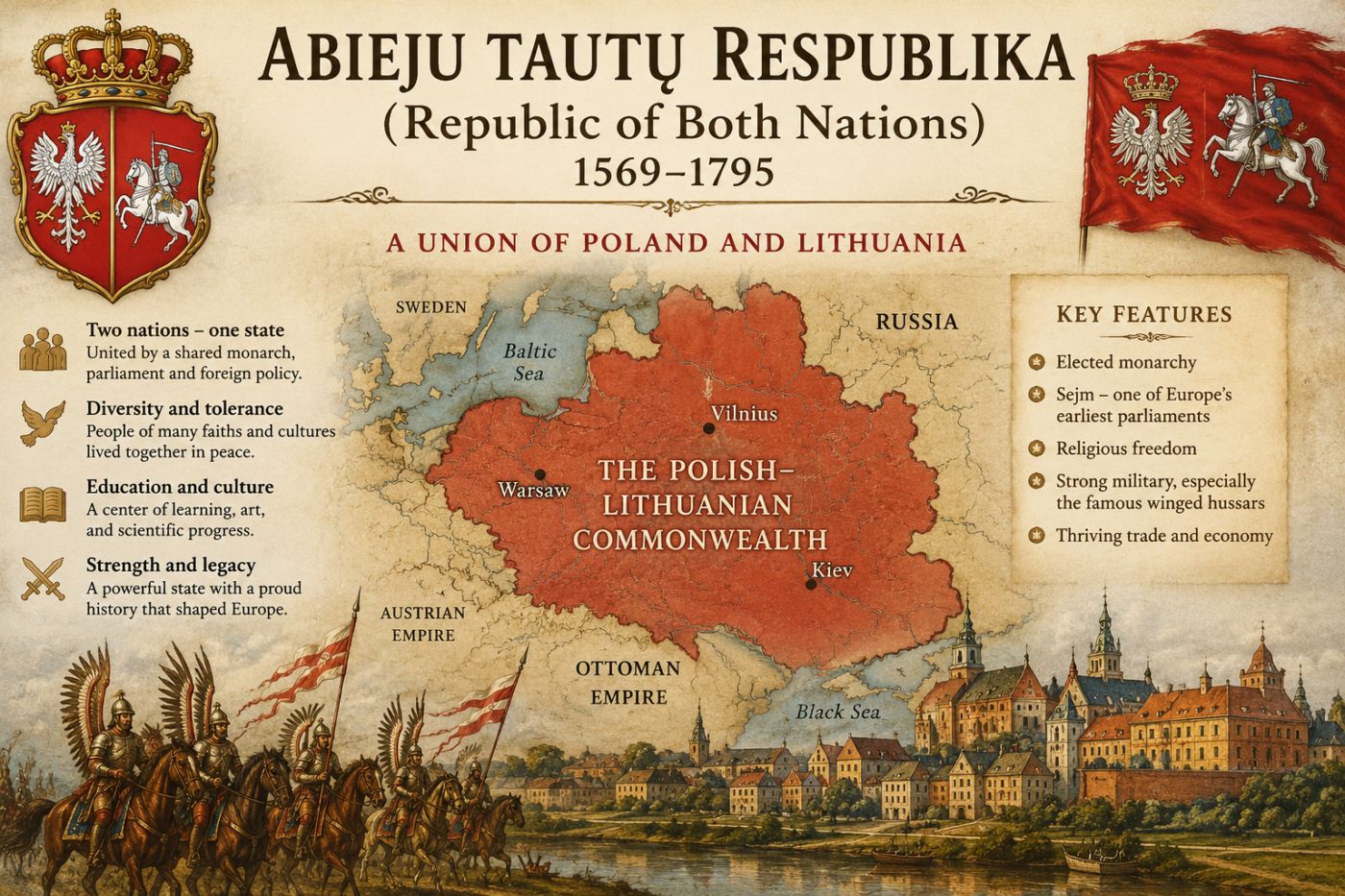

The phrase abieju tautu respublika refers to one of Europe’s most remarkable historical political unions. Although it may not be widely recognized outside academic circles, this term carries significant historical importance. It represents a state that united two nations under a shared political system while preserving many of their individual traditions and institutions. Historians often view this union as an early example of multinational cooperation that shaped the political and cultural landscape of Eastern Europe for centuries.
Understanding abieju tautu respublika helps explain the origins of many modern European borders, legal traditions, and diplomatic relationships. The state’s influence extended across vast territories, encouraging trade, education, religious diversity, and political innovation. While it eventually disappeared from the map, its legacy continues to inspire historians, political scientists, and cultural researchers.
This article explores the meaning, history, governance, achievements, challenges, and modern significance of abieju tautu respublika, providing a comprehensive overview for anyone interested in European history.
What Does Abieju Tautu Respublika Mean?
The term abieju tautu respublika is the Lithuanian name for the Polish–Lithuanian Commonwealth, a political union that existed between 1569 and 1795. In English, the phrase translates to “Republic of Both Nations.”
The two nations referred to were the Kingdom of Poland and the Grand Duchy of Lithuania. Rather than functioning as separate countries with occasional cooperation, they formed a unified state that shared a monarch, parliament, and many governmental institutions while maintaining certain independent administrative systems.
This arrangement was unique for its time because it balanced shared governance with regional autonomy. Instead of one nation completely dominating the other, both partners participated in managing the commonwealth through negotiated agreements and representative institutions.
The Origins of the Commonwealth
Early Cooperation
Before becoming a unified political entity, Poland and Lithuania had already maintained close diplomatic and military ties for centuries. Both states faced common threats from neighboring powers and realized that cooperation offered greater security.
Royal marriages between influential families strengthened these connections. Over time, military alliances evolved into deeper political cooperation, laying the groundwork for a formal union.
The Union of Lublin
The defining moment came in 1569 with the Union of Lublin. This agreement officially established the Polish–Lithuanian Commonwealth, creating what became known in Lithuanian as abieju tautu respublika.
The union introduced shared institutions while allowing each nation to preserve its legal system, military traditions, treasury, and administrative structures in several areas. This compromise made the commonwealth one of the most sophisticated constitutional arrangements of its era.
Geography and Size
At its height, abieju tautu respublika ranked among the largest countries in Europe.
Its territory included much of present-day:
- Poland
- Lithuania
- Belarus
- Ukraine
- Latvia
- Parts of Russia
The enormous territory connected Western and Eastern Europe, making the commonwealth a vital center for commerce, diplomacy, and cultural exchange.
Its diverse geography included forests, rivers, agricultural plains, and prosperous cities that supported economic growth for generations.
Government and Political Structure
An Elected Monarchy
Unlike many European kingdoms where the throne passed automatically through hereditary succession, the ruler of abieju tautu respublika was elected by members of the nobility.
This unusual system limited royal authority and increased the influence of political representatives. Every election attracted international attention because neighboring powers often sought to influence the outcome.
The Parliament
The commonwealth developed one of Europe’s earliest parliamentary traditions through its national assembly.
Representatives debated taxation, military funding, foreign policy, and legislation. Although the system promoted political participation among the nobility, it also created challenges because unanimous approval was frequently required for major decisions.
Despite its imperfections, the parliamentary tradition represented a significant step toward constitutional government.
Society and Cultural Diversity
One of the defining characteristics of abieju tautu respublika was its extraordinary cultural diversity.
People from many ethnic backgrounds lived within its borders, including:
- Poles
- Lithuanians
- Ruthenians
- Jews
- Armenians
- Germans
- Tatars
Numerous languages, customs, and religious traditions coexisted throughout the commonwealth. This multicultural environment encouraged artistic creativity and commercial development while making the state one of Europe’s most diverse societies.
Religious Tolerance
During an era when many European nations experienced violent religious conflicts, abieju tautu respublika earned recognition for comparatively high levels of religious tolerance.
Catholics, Orthodox Christians, Protestants, Jews, and Muslims often practiced their faiths with fewer restrictions than existed elsewhere in Europe.
Although tensions occasionally emerged, the state’s commitment to coexistence distinguished it from many neighboring kingdoms.
This openness attracted scholars, merchants, and skilled craftsmen who contributed to economic prosperity and intellectual development.
Economic Growth
Agriculture formed the foundation of the commonwealth’s economy.
Large estates produced grain that traveled along rivers to Baltic ports before reaching markets across Europe. International demand for agricultural products generated substantial wealth for landowners and merchants.
Beyond farming, cities became centers for:
- Trade
- Handicrafts
- Banking
- Education
- International commerce
The state’s strategic location between East and West transformed it into an important commercial corridor.
Education and Intellectual Life
Learning flourished throughout abieju tautu respublika.
Universities expanded educational opportunities for students from different regions, while printing presses increased access to literature and scholarly works.
Scientists, philosophers, writers, and legal scholars contributed to European intellectual life by exchanging ideas with institutions across the continent.
Libraries and schools became symbols of cultural advancement, reflecting the commonwealth’s appreciation for education.
Military Strength
The commonwealth maintained powerful armed forces that defended its extensive borders.
Its cavalry became especially famous throughout Europe. Skilled horsemen earned admiration for their discipline, mobility, and effectiveness in battle.
Military victories protected trade routes and preserved political independence for many decades despite repeated conflicts with neighboring powers.
However, maintaining such a large military required significant financial resources, which became increasingly difficult during periods of political disagreement.
Challenges That Weakened the Commonwealth
Despite its achievements, abieju tautu respublika encountered numerous internal and external problems.
Political disagreements often delayed important reforms.
Powerful noble families sometimes placed regional interests ahead of national priorities.
Neighboring empires grew stronger while the commonwealth struggled to modernize its institutions.
Economic inequality, military pressures, and diplomatic interference gradually weakened the state’s ability to respond effectively to emerging threats.
These difficulties accumulated over many decades rather than appearing suddenly.
The Partitions of the Commonwealth
By the late eighteenth century, neighboring powers exploited the commonwealth’s political weaknesses.
Russia, Prussia, and Austria divided its territory through a series of three partitions.
These partitions occurred in:
| Year | Historical Event |
| 1772 | First Partition |
| 1793 | Second Partition |
| 1795 | Third Partition |
After the third partition, abieju tautu respublika ceased to exist as an independent state.
Although its government disappeared, its traditions remained alive in literature, education, and national identity.
Historical Legacy
Modern historians continue to study the commonwealth because it introduced ideas that later became central to democratic governance.
Its emphasis on representative institutions, negotiated political agreements, and constitutional principles influenced later political thought throughout Europe.
Many legal traditions, educational institutions, and cultural practices developed during this period survived long after the state’s dissolution.
Today, museums, archives, historical monuments, and academic research preserve the memory of this remarkable multinational union.
Why the Commonwealth Still Matters
The history of abieju tautu respublika offers valuable lessons for today’s interconnected world.
Its experience demonstrates both the opportunities and challenges of governing diverse populations under shared institutions.
Modern discussions about regional cooperation, constitutional reform, minority rights, and international partnerships often draw comparisons with historical examples such as the Polish–Lithuanian Commonwealth.
Researchers continue examining its political innovations because they illustrate how compromise, representation, and cooperation can strengthen multinational societies.
Frequently Asked Questions
What is Abieju Tautu Respublika?
It is the Lithuanian name for the Polish–Lithuanian Commonwealth, a political union that existed from 1569 to 1795.
Which countries were part of the union?
The commonwealth united the Kingdom of Poland and the Grand Duchy of Lithuania while including territories that now belong to several modern European countries.
Why is it historically important?
It introduced a unique constitutional system, promoted religious diversity, encouraged parliamentary governance, and became one of Europe’s largest multinational states.
When did it end?
The commonwealth disappeared after the Third Partition in 1795, when neighboring powers divided its territory.
Conclusion
The story of abieju tautu respublika represents far more than the history of a vanished European state. It reflects an ambitious experiment in shared governance, constitutional development, and multinational cooperation that was centuries ahead of its time. Through political innovation, cultural diversity, educational advancement, and economic growth, the commonwealth left a lasting mark on European civilization.
Although internal divisions and external pressures eventually brought about its downfall, its legacy continues to shape historical research and public understanding of democratic traditions. Studying abieju tautu respublika provides valuable insight into how cooperation between different nations can foster stability, prosperity, and cultural exchange. Its remarkable history remains relevant today, reminding us that dialogue, compromise, and mutual respect have long been essential foundations of successful societies.










Leave a Comment