

In a business environment shaped by artificial intelligence, digital transformation, and constant disruption, knowing what an organization can actually accomplish has become increasingly important. Companies may have talented employees, sophisticated technology, and detailed strategic plans, yet still struggle to execute because they lack a clear picture of their real capabilities.
The CapabiliSense platform was developed around this challenge. It represents an attempt to use artificial intelligence and evidence-based analysis to understand organizational capability rather than relying solely on static assessments, spreadsheets, or subjective opinions. The platform was built by Andrei Savine in 2025 as an AI-governed transformation initiative, according to the project’s own website.
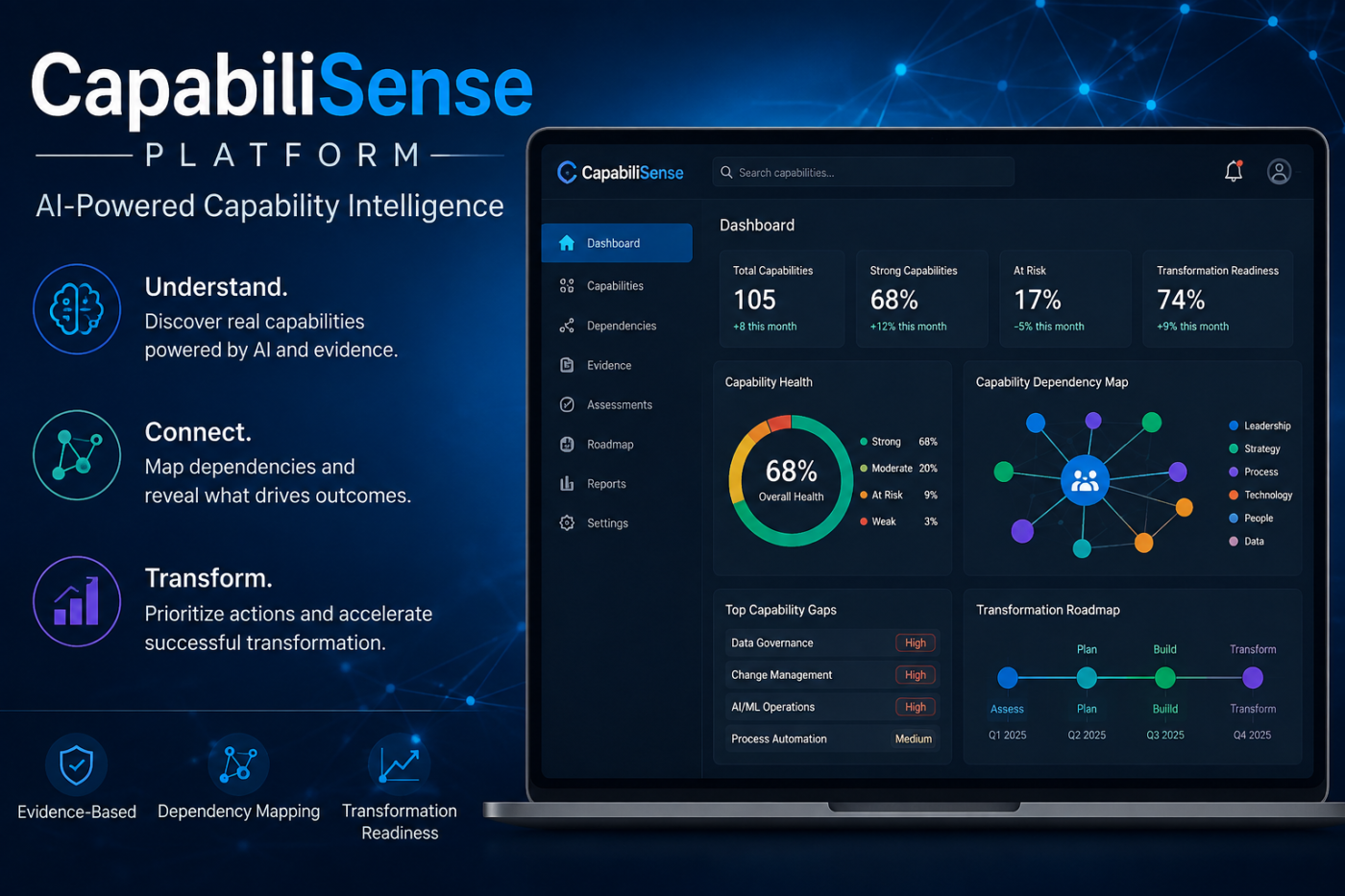
What makes the project particularly interesting is its focus on connecting evidence, capabilities, dependencies, and transformation readiness. Rather than treating capability as a simple checklist, its approach attempts to show how different organizational strengths and weaknesses interact.
What Is the CapabiliSense Platform?
The CapabiliSense platform can be described as an AI-powered capability intelligence and transformation system. Its central purpose was to help organizations understand their existing capabilities, identify gaps, and make more informed transformation decisions.
Traditional capability assessments often depend on interviews, surveys, maturity models, or manually maintained spreadsheets. These methods can provide useful information, but they may become outdated quickly. Modern organizations change continuously, while a conventional assessment usually captures only one point in time.
CapabiliSense takes a different conceptual approach. It is designed around the idea that organizational capability should be understood through evidence and relationships rather than isolated scores.
The project’s creator describes CapabiliSense platform as an AI-governed transformation platform and says that five invention declarations were registered during its development. The archived technology includes systems focused on feasibility measurement, temporal evidence, data synthesis, enterprise knowledge modeling, and adaptive maturity.
Why Capability Intelligence Matters
A company can have impressive technology and still lack the capability to use it effectively. This problem becomes particularly visible during AI adoption and digital transformation.
For example, an organization might purchase an advanced AI system but lack appropriate data governance, technical expertise, leadership alignment, or operational processes. Looking only at technology investment would hide those weaknesses.
Capability intelligence attempts to provide a broader perspective.
Instead of asking only, “What technology do we have?” organizations can ask questions such as:
- What can we reliably deliver today?
- Which capabilities are strong or weak?
- Where are important dependencies?
- What evidence supports our current assessment?
- Which gaps could prevent a transformation initiative from succeeding?
- What capabilities need to mature before another investment makes sense?
This perspective can help leaders move from ambitious plans toward realistic execution.
How the CapabiliSense Approach Works
The CapabiliSense platform available documentation suggests that the platform was designed to work with organizational evidence and structured capability models.
Rather than depending entirely on employees manually declaring their skills, the broader concept involves examining existing information and identifying signals that reveal how an organization operates.
Potential sources of evidence can include strategy documents, project information, operating models, technology structures, and other enterprise knowledge. The resulting information can then be connected into capability relationships.
This is important because organizational performance rarely depends on one isolated skill. A successful transformation may require technology, governance, data, leadership, processes, security, and workforce capabilities to work together.
A weakness in one area can therefore create a bottleneck elsewhere.
Evidence Over Assumptions
One of the project’s notable themes is the importance of evidence. The archived CapabiliSense work includes a Temporal Evidence Engine, described as a system intended to distinguish verified reality from future plans and handle ambiguity in enterprise information.
That distinction matters.
A strategic document might say that a company “will implement” a particular capability next year. Treating that statement as evidence that the capability already exists could produce a misleading assessment.
Separating current evidence from planned outcomes can make organizational analysis more realistic.
Mapping Organizational Dependencies
Another major concept is the TxOS Framework, which the project’s website describes as a machine-readable knowledge model mapping more than 105 capabilities into a directional dependency graph.
A dependency graph provides a useful way to think about transformation.
Suppose a company wants to deploy an advanced AI application. The application itself might be technically available, but successful deployment could depend on reliable data, cybersecurity, governance, infrastructure, employee skills, and change management.
A capability map can make these relationships easier to examine.
Key Concepts Behind the Platform
The CapabiliSense platform project includes several ideas that distinguish it from a conventional performance dashboard.
Graph-Native Feasibility
The CapabiliSense platform project describes a Graph-Native Feasibility Metric designed to assess current conditions and future feasibility across dependency relationships. Its purpose is to identify systemic bottlenecks rather than looking at capabilities independently.
This approach recognizes that organizational readiness is interconnected.
A company may have strong individual departments but still struggle with transformation because one critical dependency remains immature.
Agentic Data Synthesis
Another documented invention is Agentic Data Synthesis. The concept involves creating a unified evidence layer from incomplete or conflicting information and initiating interactions with humans when important information is missing or inconsistent.
This CapabiliSense platform reflects a practical challenge with enterprise data: information is rarely perfect.
Organizations frequently have duplicated records, outdated documents, contradictory plans, and missing context. An intelligent system therefore needs to recognize uncertainty instead of pretending every data point is equally reliable.
Adaptive Maturity Framework
The CapabiliSense platform project also describes an Adaptive Maturity Framework, intended to transform static maturity models into machine-readable logic.
This concept could be valuable because maturity models traditionally require human interpretation. Making the underlying rules more executable could potentially allow assessments to evolve as organizational evidence changes.
CapabiliSense and Digital Transformation
Digital transformation is often presented as a technology problem. In reality, it is usually a combination of people, processes, technology, governance, and strategy.
A business may have access to cloud computing, automation, analytics, or artificial intelligence but still lack the organizational capability required to implement those technologies successfully.
This is where the CapabiliSense philosophy becomes relevant.
The CapabiliSense platform platform’s approach focuses less on asking whether a technology exists and more on understanding whether an organization has the interconnected capabilities required to turn technology into measurable outcomes.
That distinction can be particularly important for AI projects. An AI initiative can fail because of poor data quality, unclear ownership, weak governance, inadequate workflows, or unrealistic expectations even when the underlying AI model performs well.
Potential Benefits of the Approach
An evidence-based capability system could offer several advantages for organizations.
Better Strategic Decisions
Executives often make transformation decisions using incomplete information. A structured capability map could provide additional context before major investments are approved.
Earlier Identification of Bottlenecks
Finding a capability gap before launching a large project can be considerably more useful than discovering it after resources have already been committed.
Stronger Transformation Planning
Capability relationships can help organizations understand which improvements should happen first and which initiatives depend on others.
More Transparent AI Analysis
Evidence-linked recommendations can make AI-assisted decision-making easier to scrutinize. Users can ask why a system reached a particular conclusion instead of accepting an unexplained score.
Is CapabiliSense Still Active?
This is an important distinction when researching the platform in 2026.
The official CapabiliSense platform website currently states that the startup operation has ceased, while the technology and intellectual property remain available as an archived proof of execution and library of inventions.
Therefore, readers should not assume that CapabiliSense is currently operating as a conventional commercial SaaS product.
Some third-party articles describe it as an active or emerging platform, but those descriptions conflict with the project’s own current website. For accuracy, the official source should take priority when discussing its present status.
What Makes the Project Noteworthy?
Even though the startup operation has ended, the underlying ideas remain interesting because they address a genuine problem in modern enterprise management.
Organizations generate enormous quantities of information, but information alone does not create understanding. Leaders need to know which information is reliable, how capabilities depend on one another, and where execution is likely to break down.
The CapabiliSense project attempted to approach that problem through AI, graph-based reasoning, evidence management, and adaptive capability models.
Its value, therefore, is not necessarily limited to whether the original commercial platform succeeded. The concepts developed during the project provide a useful example of how AI could be applied to organizational transformation beyond conventional chatbots and productivity tools.
Frequently Asked Questions
What is CapabiliSense?
CapabiliSense platform was an AI-governed transformation platform focused on understanding organizational capabilities, evidence, dependencies, and feasibility. Its official website now presents the technology as an archived body of work after the startup operation ceased.
Who created CapabiliSense?
The CapabiliSense platform project was created by Andrei Savine, who documented the development journey and described the platform as an attempt to address recurring problems in digital transformation.
Was CapabiliSense a normal skills-management platform?
Not exactly. Its documented focus was broader than storing employee skills. The CapabiliSense platform project emphasized organizational capability, evidence, dependency relationships, transformation readiness, and strategic feasibility.
Is CapabiliSense available as an active commercial service?
The CapabiliSense platform official website states that the startup operation has ceased. The remaining technology and intellectual property are presented as an archived proof of execution and invention library.
Final Thoughts
The CapabiliSense platform represents an interesting experiment in applying artificial intelligence to one of the hardest problems in business: understanding what an organization can genuinely accomplish.
Its emphasis on evidence, capability relationships, adaptive maturity, and transformation feasibility offers an alternative to simplistic dashboards and static assessments. More importantly, the CapabiliSense platform project highlights a lesson that remains highly relevant in the AI era: buying technology does not automatically create organizational capability.
Although the startup itself has ceased operations, its documented inventions provide a useful case study in AI-driven transformation intelligence. The broader idea is likely to remain important as organizations look for better ways to connect strategy with execution, identify hidden bottlenecks, and make technology investments based on reality rather than assumptions.








Leave a Comment