

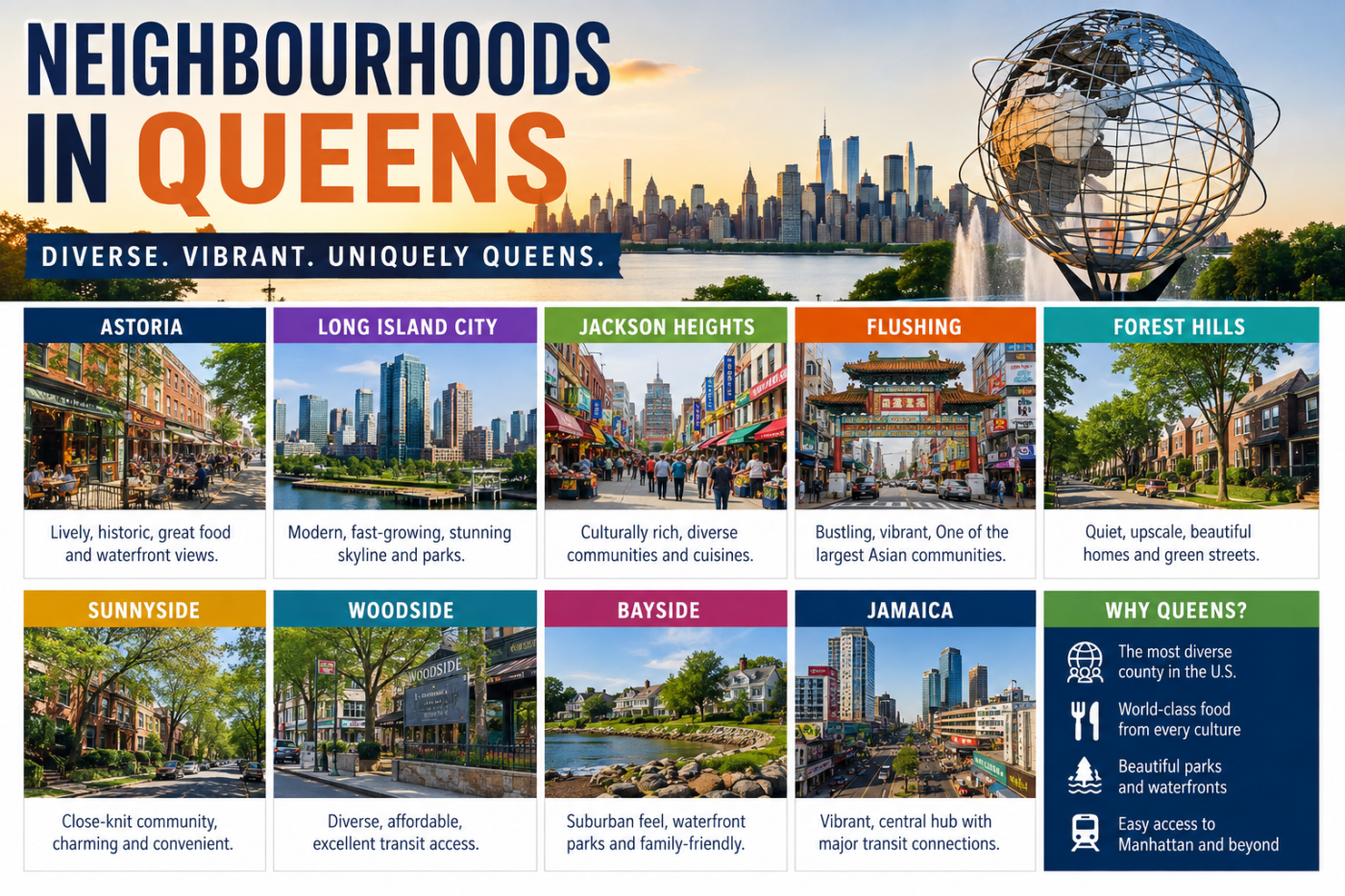

Queens is one of New York City’s most diverse and fascinating boroughs. Stretching from the East River to the Nassau County border, it combines lively urban districts, quiet residential streets, waterfront communities, historic neighborhoods, and thriving cultural hubs. For anyone planning to move, visit, or simply understand the borough better, exploring the neighbourhoods in Queens offers a useful introduction to what makes this part of New York so distinctive.
Unlike Manhattan, where major attractions often dominate the landscape, Queens feels more like a collection of individual communities. Each area has its own atmosphere, architecture, food scene, transportation options, and local identity. Astoria feels different from Flushing, while Forest Hills has a noticeably different character from Long Island City.
Understanding these differences can make it much easier to choose where to live, where to visit, or where to spend a weekend. From waterfront apartments and international restaurants to historic homes and leafy streets, Queens has an area for almost every lifestyle.
Why Queens Has So Many Distinct Neighborhoods
Its neighbourhoods in queens size has helped create a remarkably varied collection of communities.
The neighbourhoods in queens borough developed through the growth and merger of smaller settlements, transportation routes, industrial centers, and residential districts. Over time, immigration added another important layer to its identity. Today, residents from communities around the world contribute to the borough’s food, language, festivals, businesses, and cultural institutions.
That diversity is one reason the neighbourhoods in Queens can mean very different things to different people. A young professional may prefer the restaurants and subway access of Astoria or Long Island City. A family might appreciate the quieter streets of Forest Hills or Bayside. Someone searching for international cuisine may be drawn toward Flushing, Jackson Heights, or Elmhurst.
Astoria: Food, Culture, and Urban Energy
Astoria is one of the best-known communities in western Queens. It has long been associated with Greek culture, although its population today represents many different backgrounds.
The neighborhood is particularly attractive to people who enjoy restaurants, cafés, bars, and an active street scene. Steinway Street and Ditmars Boulevard are major commercial corridors, while residential blocks provide a calmer environment away from the busiest streets.
Astoria also benefits from relatively convenient transportation into Manhattan. The area is served by subway lines that connect residents with Midtown and other parts of New York City.
What Makes Astoria Stand Out?
Its biggest advantage may be the combination of urban convenience and neighborhood character.
The neighbourhoods in queens nearby Astoria Park adds another attraction. Its waterfront setting provides views of the East River and Manhattan skyline, along with recreational space for residents.
Long Island City: Modern Living by the Waterfront
Long Island City, often called LIC, has undergone one of the most dramatic transformations in Queens. Once heavily industrial, the area now features modern apartment towers, cultural institutions, restaurants, parks, and waterfront developments.
Its neighbourhoods in queens location directly across the East River from Manhattan makes it especially appealing to commuters. Multiple subway lines and other transportation connections provide access to Midtown and Lower Manhattan.
The neighbourhoods in queens waterfront is one of LIC’s defining features. Gantry Plaza State Park offers open space, walking paths, playgrounds, and impressive views across the river.
A Strong Choice for City Professionals
Long Island City is particularly attractive to residents who want modern housing while remaining close to Manhattan. New developments often include amenities that appeal to renters and buyers seeking contemporary urban living.
However, the neighborhood can feel more densely developed than some traditional Queens communities. Housing costs can also reflect its convenient location and growing popularity.
Jackson Heights: A Global Food Destination
Jackson Heights demonstrates Queens’ international character perhaps better than almost anywhere else. The neighborhood has a long history of immigration and is home to residents with roots across South Asia, Latin America, and other regions.
Its neighbourhoods in queens restaurants are a major attraction. Visitors can discover Indian, Nepali, Tibetan, Colombian, Ecuadorian, Mexican, and other cuisines without traveling far from the neighborhood.
Jackson Heights also has distinctive residential architecture. Some blocks feature cooperative apartment buildings and landscaped courtyards that reflect the neighborhood’s early twentieth-century development.
Why Visitors Love Jackson Heights
The combination of international food, historic architecture, and convenient transportation gives Jackson Heights a unique appeal. It is an excellent destination for people who want to experience the multicultural side of New York beyond the most famous tourist districts.
Flushing: A Major Asian Cultural Center
Flushing is one of the most important commercial and cultural centers in Queens. The neighborhood is particularly renowned for its Chinese and Korean communities, although its population is considerably more diverse.
Downtown Flushing neighbourhoods in queens has an enormous range of restaurants, bakeries, markets, shops, and services. Food enthusiasts can explore regional Chinese cuisines alongside Korean, Taiwanese, Southeast Asian, and other culinary traditions.
Flushing Meadows Corona Park sits nearby and provides a major recreational counterpoint to the busy commercial district.
Flushing Meadows Corona Park
The neighbourhoods in queens park is one of the borough’s most recognizable public spaces. It hosted two World’s Fairs and remains home to attractions, sports facilities, museums, and large open areas.
The neighbourhoods in queens Unisphere, a huge stainless-steel globe, is one of Queens’ most recognizable landmarks and a reminder of the area’s international history.
Forest Hills: Green Streets and Classic Architecture
Forest Hills offers a different side of Queens. Known for tree-lined streets, attractive residential architecture, and a comparatively relaxed atmosphere, it has long been popular with families and professionals.
Forest Hills Gardens is particularly notable for its carefully planned residential design. The neighbourhoods in queens neighborhood also benefits from shopping and dining around Queens Boulevard and Austin Street.
Transportation is another major advantage. Subway and rail connections make it possible to reach Manhattan and other parts of Queens without relying entirely on a car.
For people searching for quiet neighbourhoods in Queens, Forest Hills often deserves serious consideration.
Sunnyside: A Close-Knit Residential Community
Sunnyside sits west of Woodside and offers a more intimate residential atmosphere. The neighborhood is famous for Sunnyside Gardens, a planned community with distinctive homes, gardens, and landscaped spaces.
The neighbourhoods in queens area has a strong local identity and provides access to restaurants, shops, schools, and public transportation.
Sunnyside can appeal to residents who want the convenience of New York City without the intensity associated with some of its busiest districts. Its location also makes commuting into Manhattan relatively straightforward.
Woodside: Diverse, Convenient, and Community-Oriented
Woodside is another western Queens neighborhood known for cultural diversity. Its streets contain a mixture of residential buildings, restaurants, small businesses, and commercial corridors.
The neighbourhoods in queens area has strong Filipino and Irish influences, among many others. Its food scene reflects this diversity, with Filipino restaurants and bakeries standing alongside Irish pubs and establishments representing cuisines from across Asia and Latin America.
Woodside’s transportation connections make it especially practical for commuters. The neighborhood is served by subway and rail services, providing several options for getting around the city.
Bayside: Suburban Character in New York City
Bayside is located in northeastern Queens and has a distinctly suburban feel. It features detached homes, quieter streets, parks, and local shopping areas.
The neighborhood can be attractive to families and residents who prioritize space and a calmer environment. Bayside also has access to parks and waterfront areas, giving residents opportunities for outdoor recreation.
Its distance from Manhattan means commuting can take longer than from western Queens, but that trade-off can appeal to people who value residential tranquility.
Jamaica: A Major Transportation and Cultural Hub
Jamaica is one of Queens’ most important transportation centers. The neighborhood connects subway, bus, and rail services, including routes toward Manhattan and Long Island.
Beyond transportation, Jamaica has a long and complex history and a diverse population. Commercial streets support numerous local businesses, restaurants, and services.
Major development projects have also brought changes to parts of the area. For visitors, Jamaica can serve as an important gateway to other parts of Queens and Long Island.
What Should You Consider When Choosing a Queens Neighborhood?
Choosing among the many neighbourhoods in Queens requires more than simply looking at rental or property prices. Your daily routine should guide the decision.
Transportation is one of the first factors to examine. If you commute to Manhattan every day, living close to a reliable subway or rail connection can save considerable time.
Housing style also matters. Some neighbourhoods in queens communities offer modern high-rise apartments, while others are dominated by co-ops, townhouses, or detached homes.
You should also consider access to parks, schools, restaurants, grocery stores, healthcare facilities, and other everyday services. A neighborhood that looks appealing on paper may not suit your lifestyle if basic amenities are inconveniently located.
Finally, spend time in the area at different times of day. A neighborhood can feel completely different during a quiet weekday morning, a busy evening, or a weekend afternoon.
Queens Offers More Than One Version of New York
One of Queens’ greatest strengths is its variety. The borough does not have a single personality. Instead, it offers dozens of distinct local experiences connected by an extensive transportation network and a shared New York identity.
You can enjoy waterfront views in Long Island City, explore global cuisine in Jackson Heights and Flushing, relax among leafy streets in Forest Hills, or experience the lively atmosphere of Astoria. Further east, communities such as Bayside provide a quieter residential lifestyle.
That variety makes Queens particularly interesting for both visitors and residents. Rather than choosing a neighborhood based solely on reputation, take time to understand what each community offers.
Conclusion
The neighbourhoods in Queens reveal why the borough remains such an important part of New York City. Its communities combine cultural diversity, historic character, modern development, excellent food, public parks, and transportation connections in remarkably different ways.
Whether you prefer an energetic urban environment, a multicultural food destination, a waterfront setting, or a peaceful residential street, Queens provides plenty of choices. The best area ultimately depends on your priorities, budget, commute, and lifestyle.
Most importantly, Queens rewards exploration. Walk its streets, visit local businesses, try its restaurants, and experience its parks. Once you look beyond the map, you discover that every neighborhood has its own story—and that is what makes Queens one of New York’s most compelling boroughs.










Leave a Comment