

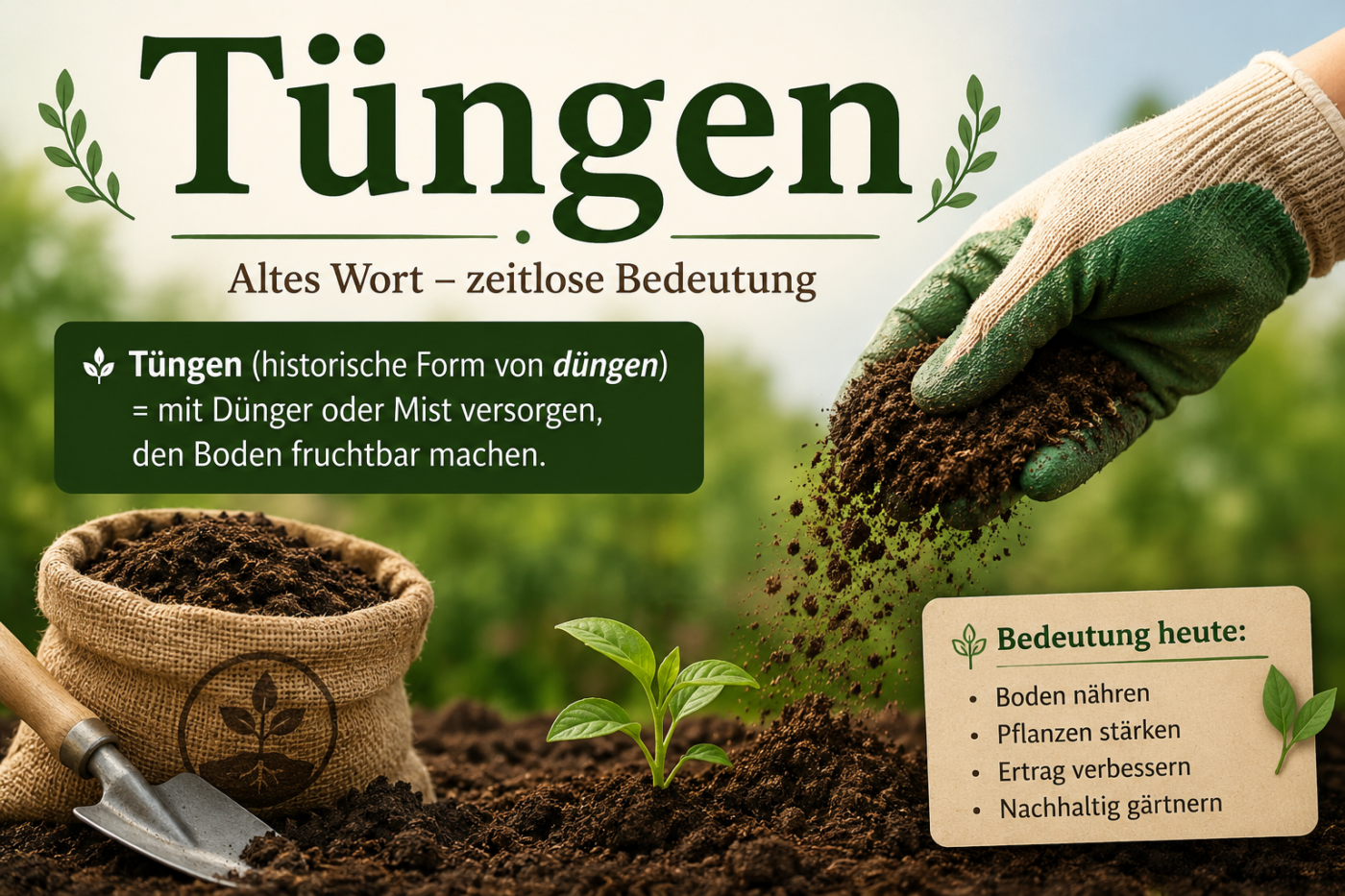

Language often preserves traces of the past in words that look unfamiliar today. Tüngen is a good example. Although the spelling may seem unusual to modern readers, it has a meaningful connection with the history of Germanic vocabulary. In particular, historical forms related to tüngen developed into the modern German verb düngen, which means to fertilize soil or enrich land with manure or fertilizer.
Understanding this word requires more than simply translating it. Its story reaches into historical German, agricultural vocabulary, and the development of Germanic languages. The older form also helps explain why modern words associated with farming and soil improvement have the forms they do today.
This article explores the meaning, linguistic background, historical development, and modern relevance of tüngen. It also explains how the term relates to düngen and why older spellings can still be valuable when studying language history.
What Does Tüngen Mean?
The form tüngen is best understood in a historical linguistic context rather than as a common modern German word. The modern German verb düngen means “to fertilize,” “to manure,” or “to enrich soil with fertilizer.” Duden defines düngen as adding fertilizer to soil and also notes that something such as decaying leaves can function as fertilizer.
The word is particularly associated with agriculture, soil fertility, crops, and plant growth. Farmers fertilize fields because plants remove nutrients from soil as they grow. Replacing those nutrients helps maintain productive land.
The historical connection is especially interesting because Duden traces düngen to Middle High German tungen. Wiktionary likewise identifies historical forms such as tüngen and connects the modern verb to older Germanic vocabulary associated with dung and fertilizer.
Tüngen and the Modern German Word Düngen
One of the most important points is the relationship between tüngen and düngen. Someone encountering the older spelling might assume that the two words are unrelated. Linguistic evidence shows otherwise.
Modern German uses düngen as the standard form. It is a weak verb, and its forms include düngt, düngte, and hat gedüngt. Its basic meaning is to supply soil or plants with fertilizer.
Historical language, however, did not always use the same spelling found in contemporary German. Sound changes, regional pronunciation, spelling conventions, and grammatical development gradually transformed older forms.
From Tungen to Düngen
The historical development can be viewed broadly as a movement from older forms connected with tung/tungen toward the modern dung/düngen word family.
Wiktionary traces düngen through Middle High German tüngen and Old High German forms, ultimately connecting it with the noun Dung, meaning dung or manure.
This illustrates a broader principle in historical linguistics: words do not remain frozen. Their spelling and pronunciation can shift over centuries while their central meaning remains recognizable.
The Agricultural Meaning Behind the Word
The connection between this vocabulary and farming is straightforward. Continuous cultivation can reduce available nutrients, making fertilization an important agricultural practice.
Traditional farmers commonly relied on animal manure, compost, plant residues, and other organic materials. Modern agriculture also uses manufactured fertilizers containing nutrients such as nitrogen, phosphorus, and potassium.
The old word family therefore reflects an activity that has been fundamental to human civilization for thousands of years: improving soil so that it can produce food.
Fertilizing Soil
To fertilize means to add substances that improve nutrient availability. Depending on the farming system, this may involve organic or mineral materials.
Organic approaches can include compost, manure, crop residues, and other naturally derived materials. Mineral fertilizers, by contrast, are manufactured or processed to provide specific nutrients.
The underlying goal remains similar: support plant growth by managing soil nutrients.
Why Historical Words Matter
A word such as tüngen may appear obscure to someone who only studies modern German. Yet historical vocabulary can reveal how people lived, worked, and communicated.
Agricultural words are particularly valuable because farming shaped everyday life for centuries. Terms connected with fields, livestock, manure, crops, harvests, and soil frequently became deeply established in European languages.
Studying older vocabulary can therefore provide insight into linguistic history and agricultural history at the same time.
It also demonstrates how modern vocabulary developed gradually rather than appearing suddenly in its present form.
Tüngen in Historical Germanic Linguistics
The history of tüngen extends beyond modern German. Related words can be found across Germanic languages, although their meanings and forms differ.
Wiktionary connects the modern German verb to older Germanic vocabulary and identifies an etymological relationship with Dung.
This is significant because Germanic languages share many inherited words. Over time, individual languages developed their own pronunciation patterns, spelling systems, and grammatical structures.
Consequently, comparing related words can help linguists reconstruct earlier stages of a language and understand how vocabulary changed.
A Link to the Word Dung
The modern German noun Dung refers to manure or animal excrement used in agricultural contexts. The relationship between Dung and düngen is therefore logical: one refers to the material, while the verb describes the agricultural action associated with using it.
The historical dictionary evidence also shows that older forms of düngen could refer to making land fertile or supplying an agricultural field with dung.
This connection gives the word a remarkably transparent agricultural history.
Is Tüngen a Modern German Word?
Readers should be careful when treating tüngen as a standard modern German spelling. Contemporary German dictionaries identify düngen as the established form.
Therefore, if you are writing modern German, düngen is generally the appropriate form for the meaning “to fertilize.”
The older spelling is more relevant when examining historical texts, etymology, dialectal development, or the evolution of German vocabulary.
This distinction matters because historical spellings can appear in linguistic databases or older documents without being standard contemporary vocabulary.
How Düngen Is Used Today
Modern German speakers can use düngen in several agricultural and gardening contexts. Someone may fertilize a vegetable garden, agricultural field, lawn, flower bed, or individual plants.
For example, the verb can describe supplying soil with fertilizer before planting or adding nutrients during a growing season.
The word can also be used figuratively or descriptively in certain contexts. Duden notes that something such as decaying leaves can itself act as fertilizer.
This reflects an important ecological principle: natural decomposition returns nutrients to the soil.
Organic Fertilization and Traditional Farming
The historical meaning of this word family naturally connects with traditional farming practices. Before modern synthetic fertilizers existed, farmers depended heavily on materials available around the farm.
Animal manure was especially valuable because it contained nutrients that could return to cultivated soil. Composting and the recycling of plant material also helped maintain fertility.
These practices remain relevant today. Many gardeners continue to use compost and well-managed organic matter because they can improve soil structure while contributing nutrients.
The historical vocabulary surrounding fertilization therefore remains connected to modern discussions about sustainable agriculture and soil management.
Why Spelling Changes in Language
The difference between tüngen and düngen is an excellent example of why spelling should not always be treated as permanent.
Languages change through pronunciation shifts, regional variation, contact between dialects, and changing writing conventions. A word can retain its basic meaning while its written form changes considerably.
Historical German is filled with examples of vocabulary that looks unfamiliar to modern readers but becomes understandable once its development is traced.
That is why etymological research often looks beyond modern dictionaries and examines older forms.
Tüngen as a Window Into the Past
Although tüngen is not a common modern English or German word, its historical significance makes it worth examining. It connects modern düngen with older forms and with a vocabulary system centered on dung, soil, and fertility.
The word also demonstrates how closely language can reflect everyday human activity. Agriculture was not simply an economic practice; it influenced the vocabulary people used to describe their environment and work.
By studying older terms, researchers can see how concepts were expressed before modern standardized languages emerged.
Frequently Asked Questions
What is the meaning of tüngen?
Tüngen is a historical form associated with the modern German verb düngen, meaning to fertilize or enrich soil. Historical sources connect the word with older forms related to dung and agricultural fertilization.
Is tüngen modern German?
The standard modern German form is düngen, not tüngen. The latter is mainly relevant to historical linguistic study and the development of the modern word.
What does düngen mean?
Düngen means to add fertilizer to soil or plants. It can also describe something functioning as fertilizer, such as decomposing organic material.
Where does düngen come from?
The word has historical roots in older Germanic vocabulary. Duden traces it to Middle High German tungen, while other etymological sources connect it with older forms and the noun Dung.
Conclusion
The story of tüngen shows how a seemingly obscure word can open a window into language, agriculture, and history. Its strongest modern connection is with German düngen, the verb meaning to fertilize soil. Historical sources trace this modern form through older Germanic and Middle High German forms, ultimately linking it with vocabulary associated with dung and soil fertility.
For modern German usage, düngen is the form to remember. For students of etymology, however, tüngen offers something more: evidence of how words evolve while preserving traces of their original meanings.
In that sense, this small historical term tells a much larger story. It reminds us that language grows much like the soil described by the word itself—layer by layer, shaped by time, use, and generations of human experience.








Leave a Comment