

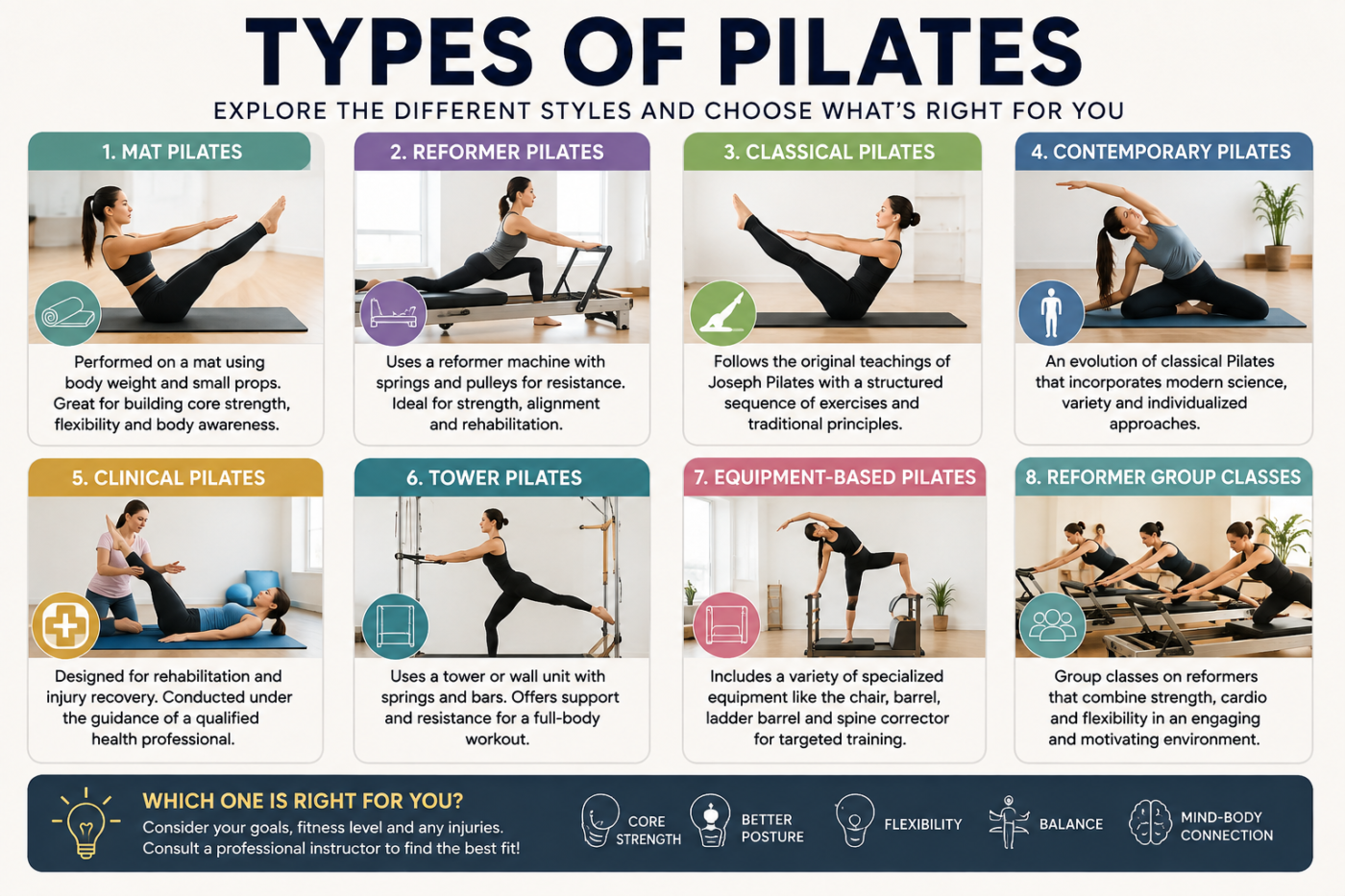

Pilates has evolved from a specialized movement system into a widely practiced form of exercise for people with very different goals. Some individuals use it to improve flexibility and posture, while others want greater core strength, better balance, or a low-impact alternative to conventional workouts. Because modern Pilates includes several approaches, choosing the right one can feel confusing at first.
Understanding the types of Pilates makes that choice much easier. Although most methods share principles such as controlled movement, breathing, concentration, and core engagement, each style uses different equipment, techniques, and training environments. Some sessions take place entirely on a mat, while others use specialized machines to create resistance and support.
This guide explains the major Pilates styles, how they differ, and who may benefit from each approach. Whether you are a complete beginner or looking for a new challenge, learning these distinctions can help you find a practice that fits your needs.
What Is Pilates?
Pilates is a structured exercise system developed around controlled, deliberate movements. Joseph Pilates originally called his method “Contrology,” emphasizing precise body control rather than simply performing a large number of repetitions.
The types of pilates exercises generally focus on the core muscles, but Pilates involves much more than abdominal training. Depending on the routine, you may work your hips, shoulders, legs, back, and smaller stabilizing muscles. Proper breathing and concentration also play an important role.
Unlike many high-impact workouts, Pilates usually places relatively little stress on the joints. This characteristic makes it appealing to people who want to develop strength and mobility without relying heavily on jumping or rapid movements.
The Main Types of Pilates
Modern studios offer several forms of Pilates. The most common options include mat Pilates, reformer Pilates, classical Pilates, contemporary Pilates, clinical Pilates, and specialized equipment-based sessions.
While these methods overlap, their differences can significantly affect the experience.
1. Mat Pilates
Mat Pilates is often the simplest starting point because it requires minimal equipment. Most exercises are performed on a padded mat using body weight as the primary source of resistance.
A typical session may include movements such as pelvic curls, leg circles, bridges, planks, abdominal exercises, and controlled stretching. Small accessories such as resistance bands, Pilates rings, or soft balls may also appear in some classes.
The types of pilates major advantage is accessibility. You can practice mat exercises at home, in a studio, or while traveling. Beginners can learn fundamental movement patterns without first becoming familiar with a machine.
Mat Pilates is particularly useful for developing core stability, coordination, posture, and body awareness.
2. Reformer Pilates
Reformer Pilates uses a specialized machine called the reformer. The apparatus contains a sliding carriage, springs, straps, and a stable frame. These components allow exercises to be performed with adjustable resistance.
The types of pilates reformer can make certain movements more challenging, but it can also provide support. That versatility explains why the equipment is used for both general fitness and specialized exercise programs.
One session might involve controlled leg movements, arm exercises, lunges, abdominal work, or full-body sequences. The springs can be changed according to the participant’s ability and the instructor’s objectives.
For people who enjoy resistance training but want a controlled, low-impact approach, reformer Pilates can be an excellent option.
3. Classical Pilates
Classical Pilates follows the original system associated with Joseph Pilates and later instructors who preserved his teaching tradition. It generally places considerable emphasis on a structured sequence of exercises and the principles of traditional Contrology.
A classical session may follow a recognizable progression rather than randomly selecting movements. The exercises are performed with attention to technique, breathing, control, and precision.
This types of pilates style can appeal to practitioners who appreciate historical methods and consistent programming. However, some traditional exercises may require considerable strength, flexibility, and coordination.
Beginners should therefore work at an appropriate level instead of attempting advanced movements simply because they appear in the traditional repertoire.
4. Contemporary Pilates
Contemporary Pilates builds upon traditional principles while incorporating ideas from modern exercise science, biomechanics, physical therapy, and movement education.
Instructors may modify traditional exercises to accommodate different body types, abilities, training objectives, or movement limitations. They can also introduce additional equipment or alternative exercise sequences.
This approach is generally flexible rather than strictly tied to one historical sequence. As a result, two contemporary Pilates classes may look quite different.
For many modern participants, that adaptability is a major advantage. The instructor can emphasize mobility, strength, balance, or movement quality according to the needs of the group.
5. Clinical Pilates
Clinical Pilates is commonly associated with physiotherapy and rehabilitation settings. It uses Pilates-based movements while considering an individual’s physical condition, movement patterns, and rehabilitation objectives.
A types of pilates qualified healthcare professional may adapt exercises for someone recovering from an injury or dealing with specific movement limitations. The emphasis is usually on controlled movement and appropriate progression rather than simply completing an intense workout.
Clinical Pilates should not be confused with a standard fitness class. If you have a diagnosed condition, significant pain, or a recent injury, professional assessment may be appropriate before beginning an exercise program.
6. Equipment-Based Pilates
Although the reformer receives the most attention, Pilates studios can use many other pieces of equipment. These include the Cadillac or trapeze table, Pilates chair, ladder barrel, spine corrector, and various small props.
Each apparatus changes the way resistance, balance, or support is provided.
For example, the Pilates chair can challenge stability and lower-body strength, while the Cadillac offers numerous options for supported and resisted movements. Barrels may help participants explore spinal mobility and positioning.
Equipment-based sessions are particularly appealing to people who enjoy variety and want to progress beyond basic mat exercises.
7. Tower Pilates
Tower Pilates uses a wall-mounted or freestanding apparatus featuring springs, bars, and attachment points. It provides many of the resistance and support possibilities associated with larger Pilates equipment while often occupying less space than a full reformer setup.
The types of pilates springs can create resistance during both upper- and lower-body exercises. They can also assist movement, making the system useful for controlled strength and mobility work.
Tower classes can vary considerably depending on the instructor and studio. Some resemble traditional mat sessions with additional resistance, while others use the apparatus extensively throughout the workout.
8. Reformer-Based Group Classes
Reformer classes have become especially popular in boutique fitness studios. Participants typically work on individual reformer machines while following an instructor through a structured routine.
These classes can range from beginner-friendly sessions to demanding workouts involving advanced balance, strength, and coordination.
The types of pilates main attraction is the combination of controlled resistance and full-body movement. However, the equipment can make unfamiliar exercises difficult to understand initially. Beginners should communicate with the instructor and prioritize technique over speed.
How the Different Pilates Styles Compare
| Pilates Style | Main Feature | Best For |
|---|---|---|
| Mat Pilates | Body-weight movements | Beginners and home workouts |
| Reformer Pilates | Spring-based resistance | Strength and progression |
| Classical Pilates | Traditional sequence | Those seeking the original method |
| Contemporary Pilates | Modern adaptations | Flexible, individualized training |
| Clinical Pilates | Rehabilitation-focused approach | Certain recovery programs |
| Tower Pilates | Springs and bars | Resistance and mobility |
| Equipment Pilates | Specialized apparatus | Variety and advanced practice |
The “best” option depends less on popularity and more on your personal goals, experience, and access to qualified instruction.
How to Choose the Right Type of Pilates
Start by identifying what you want from your workouts. If you need a convenient routine that requires little equipment, mat Pilates is an obvious choice. A mat and comfortable clothing may be enough to begin.
If you want adjustable resistance and enjoy studio-based training, consider reformer Pilates. Its springs allow exercises to be progressed or modified according to your abilities.
People interested in rehabilitation should seek appropriate professional guidance rather than choosing a demanding class based solely on its popularity. Meanwhile, experienced practitioners may enjoy classical, contemporary, or equipment-focused sessions that provide greater technical challenges.
The types of pilates instructor also matters. A well-qualified instructor can explain positioning, offer modifications, and recognize when an exercise needs to be adjusted.
Benefits Shared Across Pilates Styles
Despite their differences, many forms of Pilates share several potential benefits. Regular practice may support improved muscular endurance, balance, flexibility, posture, coordination, and body awareness.
Pilates can also complement other forms of exercise. For example, runners may use it as a way to develop strength and movement control, while people who perform resistance training may appreciate its emphasis on stability and precision.
However, results depend on consistency, technique, appropriate progression, and individual circumstances. types of pilates is not a substitute for every form of physical activity. A balanced fitness routine may include cardiovascular exercise, resistance training, mobility work, and adequate recovery.
Common Mistakes Beginners Should Avoid
One common mistake is trying to perform advanced exercises before mastering basic movements. Pilates rewards precision, so rushing through an exercise can reduce its value.
Another mistake involves holding the breath. Breathing is an important part of Pilates technique and can help support controlled movement.
Beginners should also avoid comparing themselves with experienced participants. Flexibility and coordination develop at different rates. A types of pilates simpler variation performed correctly is usually more valuable than an advanced movement performed poorly.
Finally, do not assume that a more difficult class automatically produces better results. The most effective workout is one that challenges you appropriately while allowing you to maintain good technique.
Frequently Asked Questions
Is Pilates good for beginners?
Yes. Many Pilates exercises can be modified for different fitness levels. Mat Pilates is often a convenient introduction because it requires little equipment.
Which type of Pilates is the hardest?
Difficulty depends on the types of pilates instructor, exercise selection, and participant’s experience. Advanced reformer, classical, and equipment-based sessions can all become highly challenging.
Can Pilates build strength?
Pilates can improve muscular strength and endurance, particularly through controlled resistance and repeated movement. The types of pilates amount of strength development depends on the types of pilates exercises, resistance, progression, and individual training history.
Should I start with mat or reformer Pilates?
Mat Pilates is generally easier to access and learn independently, while reformer Pilates provides adjustable resistance and additional movement options. A types of pilates beginner can start with either under suitable instruction.
Conclusion
The different types of pilates offer more variety than many newcomers realize. Mat sessions provide simplicity and accessibility, reformer workouts introduce adjustable resistance, classical classes preserve traditional principles, and contemporary approaches offer greater flexibility. Clinical and equipment-based methods can serve more specialized purposes.
Rather than searching for the single “best” Pilates style, consider your goals, experience, physical needs, and preferred training environment. Start at an appropriate level, learn the types of pilates fundamentals, and progress gradually. With consistent practice and quality instruction, Pilates can become a valuable part of a balanced approach to strength, mobility, posture, and overall physical fitness.









Leave a Comment