

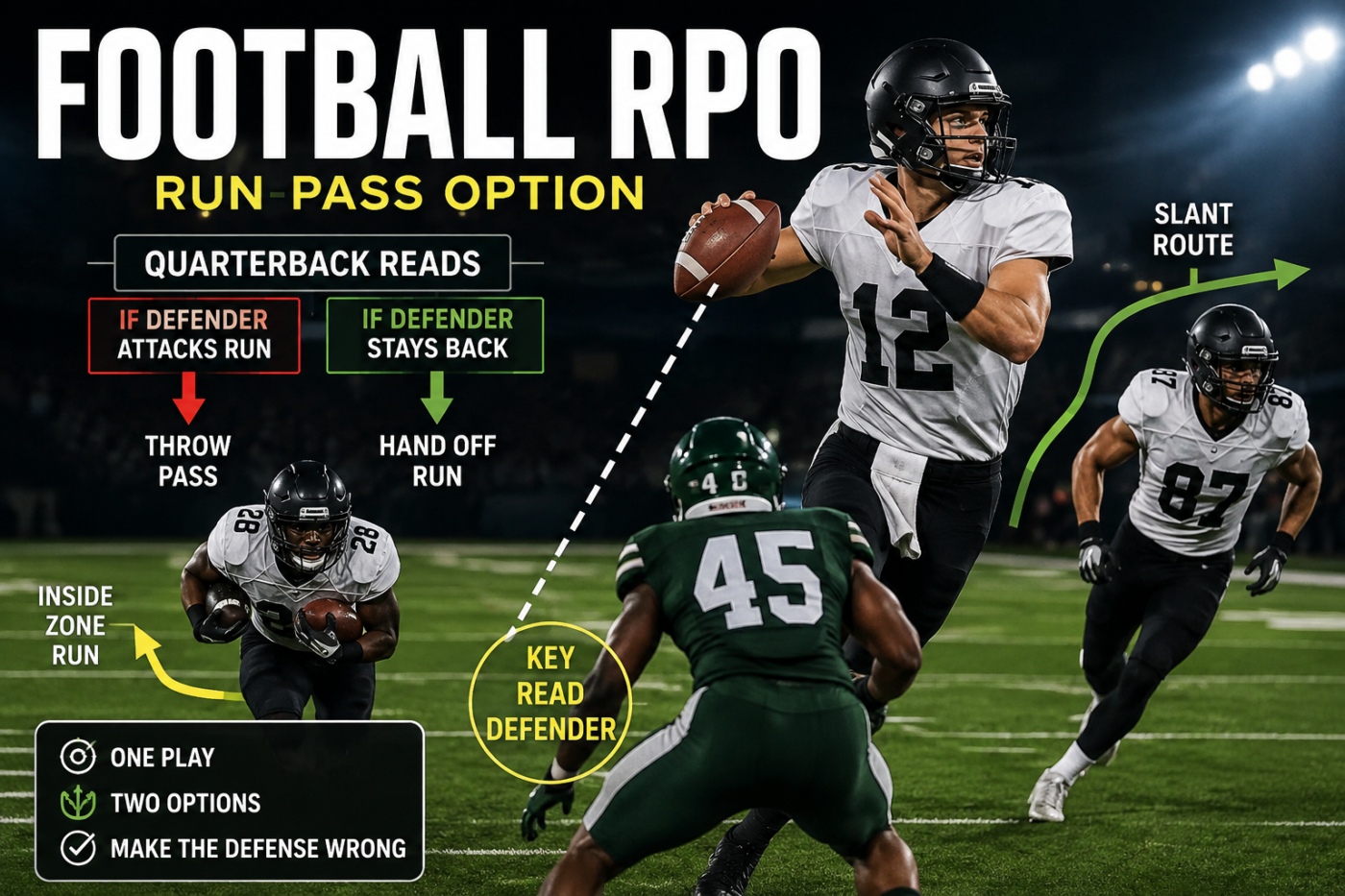

In modern football, offensive success often depends on making defenders wrong before the play fully develops. One of the most effective ways to create that conflict is the run-pass option, commonly called an RPO. This approach gives the quarterback a choice between a running play and a quick passing concept based on how the defense reacts.
The idea sounds simple, but executing an RPO requires timing, discipline, communication, and a strong understanding of defensive alignment. Coaches use these plays to stretch defenders horizontally and vertically, while quarterbacks must quickly identify the defender who determines the correct decision.
Understanding football RPO concepts can help players, coaches, and fans appreciate why these plays have become such an important part of modern offensive systems.
What Is an RPO in Football?
An RPO, or run-pass option, is an offensive play design that combines a running action with a passing option. Instead of deciding before the snap whether the offense will run or pass, the quarterback reads a designated defender after the ball is snapped.
The football rpo quarterback typically begins the play as though the offense is running the football. At the same time, one or more receivers execute a predetermined passing route. The quarterback then evaluates the defender’s movement and chooses the appropriate option.
For example, if a defender moves toward the running back to stop the handoff, the quarterback may pull the ball and throw to a receiver. If that defender stays with the receiver, the quarterback may allow the running play to continue.
This creates a defensive conflict. One defender may effectively be responsible for two possible threats, forcing him to make a difficult decision in a fraction of a second.
How Does a Football RPO Work?
An RPO usually begins with a traditional offensive formation. The quarterback takes the snap while the running back moves toward the point of attack. Meanwhile, a receiver may run a slant, bubble screen, hitch, glance, or another quick route.
The quarterback reads a specific defender rather than simply scanning the entire defense. That football rpo defender might be a linebacker, safety, or defensive end, depending on the design.
The Pre-Snap Read
Before the snap, the quarterback examines the defensive formation. He may identify the number of defenders in the box, recognize potential blitzes, and determine whether the defense is showing favorable coverage.
This football rpo information can influence the quarterback’s expectations, although the final decision often comes after the snap.
The Post-Snap Read
After receiving the ball, the quarterback watches the assigned defender. The defender’s movement determines which option becomes most attractive.
If the defender attacks the run, the quarterback can keep the ball and throw. If the defender stays outside to defend the pass, the quarterback can hand the ball to the running back.
The football rpo quarterback must make this decision quickly. Holding the football too long can disrupt the timing of the entire play.
Common Types of RPO Concepts
RPOs are not a single play. They represent a family of offensive concepts that coaches can adapt to different personnel and defensive structures.
Inside Run With a Slant
One popular concept combines an inside run with a quick slant route. The quarterback watches an inside linebacker or nearby defender.
If the defender crashes toward the running lane, the quarterback may pull the football and throw the slant. If the defender remains positioned to protect the passing lane, the quarterback can hand the ball off.
This football rpo design can be particularly effective when the offense has a receiver capable of winning quickly against man or zone coverage.
Run With a Bubble Screen
Another common variation pairs a running play with a bubble screen. The outside receiver moves toward the sideline while blockers attempt to create space.
The football rpo quarterback can throw the screen if the defense leaves the receiver uncovered or provides favorable numbers. Otherwise, the quarterback can continue with the running play.
This concept forces the defense to account for both the interior run and the perimeter.
Glance RPO
A glance RPO typically combines an inside run with a quick vertical-breaking route, often called a glance or skinny post.
The receiver attacks space behind an aggressive linebacker. If the linebacker steps forward to stop the run, the quarterback can throw behind him.
Because the route develops quickly, timing becomes extremely important. The quarterback must recognize the defender’s movement and deliver the ball before the passing window disappears.
Why Teams Use RPOs
The football rpo popularity of RPO football comes from its ability to simplify certain defensive decisions while creating multiple offensive possibilities.
Instead of asking every defender to react to only one threat, an RPO can force a defender to account for both the run and the pass.
Creating Numerical Advantages
Football is often a numbers game. Offenses want favorable matchups and enough blockers at the point of attack.
An RPO can manipulate those numbers by making a defender hesitate. If the defender cannot immediately commit to the running game, the offense may gain additional space for the ball carrier.
Punishing Aggressive Defenders
Defenses often rely on linebackers and safeties to attack quickly against running plays. An RPO can turn that aggression into an advantage for the offense.
When a defender reacts too aggressively, the quarterback may pull the ball and attack the space that the defender abandoned.
Increasing Offensive Flexibility
RPOs can also make an offensive system more flexible. Coaches can build several variations from similar formations and motions, making it harder for defenses to predict the final play.
The football rpo same alignment might produce a run on one snap and a quick pass on another.
The Quarterback’s Role in an RPO
The quarterback is central to successful RPO execution. Although the play may appear straightforward from the stands, the quarterback has several responsibilities.
First, the quarterback must understand the defensive structure before the snap. Next, he must identify the correct read defender. After the snap, he must maintain proper footwork while observing that defender.
Finally, he must make a fast and decisive choice.
A quarterback who hesitates can lose the advantage created by the design. Conversely, a quarterback who makes poor reads may repeatedly choose the wrong option.
Decision-Making and Timing
Good RPO quarterbacks combine quick decision-making with controlled mechanics. They do not simply guess what the defense will do. Instead, they football rpo follow the progression established by the offensive design.
Timing matters because many RPO passes are intentionally thrown quickly. The quarterback must release the ball while the receiver is entering the intended throwing window.
How Defenses Defend RPOs
As RPOs have become more common, defensive coordinators have developed several strategies for limiting them.
One approach involves disciplined defensive alignment. Rather than aggressively chasing the first apparent threat, defenders may maintain their responsibilities and force the quarterback to make a difficult decision.
Defenses can also use different coverage structures, pressure packages, and personnel combinations to reduce the effectiveness of particular RPO concepts.
Defensive Discipline Matters
The biggest challenge for defenders is avoiding overreaction. If a linebacker immediately crashes toward the running back, he may create an easy passing opportunity.
If he focuses too heavily on the receiver, however, the offense may gain yards on the ground.
The football rpo defense therefore attempts to maintain balance while communicating responsibilities clearly.
Advantages and Limitations of RPO Football
RPOs offer several benefits, but they are not automatically successful.
Their biggest advantage is conflict creation. By combining multiple threats into one play, an offense can make a defender responsible for more than one area.
RPOs can also provide efficient short passing opportunities and help an offense attack defensive tendencies.
However, the approach has limitations. Quarterbacks need excellent recognition skills, receivers must execute their routes correctly, and offensive linemen must understand their responsibilities.
Poor timing can turn an attractive RPO into a negative play.
RPO vs. Play-Action
RPOs and play-action passes can look similar, but they operate differently.
In a traditional play-action concept, the quarterback generally has a predetermined passing responsibility. The fake handoff is designed to influence defenders before the quarterback completes the pass.
An RPO gives the quarterback a genuine choice between the run and pass based on the post-snap read.
That distinction is important. Play-action attempts to sell the run while executing a pass, whereas an RPO incorporates the possibility of actually running the football.
RPOs in Modern Offensive Football
The football rpo rise of RPO systems reflects a broader evolution in offensive football. Coaches increasingly look for ways to put defenders in difficult situations while maximizing the skills of their quarterbacks and playmakers.
Spread formations, mobile quarterbacks, versatile running backs, and athletic receivers can make these concepts especially dangerous.
At the same time, RPOs work best when they fit naturally into the larger offensive system. A team cannot rely on one concept alone. Successful offenses combine RPOs with traditional runs, screens, drop-back passes, play-action, and other formations.
This variety prevents defenses from becoming comfortable and allows coaches to attack weaknesses throughout a game.
How Players Can Improve at RPO Execution
Players can improve their performance by studying both the offensive design and defensive reactions.
Quarterbacks should learn to identify the designated read defender and practice making decisions quickly. Running backs need consistent mesh-point mechanics because the quarterback’s decision depends partly on how convincingly the handoff action develops.
Receivers must run precise routes and understand spacing. Offensive linemen also need to know their blocking responsibilities and execute them without hesitation.
Film study is particularly valuable. Reviewing previous plays can reveal defensive tendencies that may not be obvious during live action.
The Future of RPO Offenses
The football rpo is likely to remain an important feature of offensive football because it matches the game’s continuing emphasis on space, speed, and decision-making.
As defenses develop better ways to handle these concepts, offensive coaches will continue creating variations that place defenders in new conflicts.
The most effective systems will not simply run RPOs repeatedly. Instead, they will use them as part of a broader offensive philosophy designed to attack specific defensive weaknesses.
Conclusion
Football RPO concepts have changed the way modern offenses approach defensive decision-making. By combining running and passing possibilities into a single play, an RPO can force defenders to hesitate, create numerical advantages, and open valuable space for offensive playmakers.
However, the success of an RPO depends on more than clever play design. Quarterback decision-making, precise timing, disciplined blocking, receiver execution, and defensive recognition all contribute to the final result.
Once you understand the basic read structure, an RPO becomes much easier to recognize on the field. What may initially look like a simple handoff or quick pass is actually a carefully designed decision point that puts pressure on the defense. That strategic element is precisely why the football rpo option has become such a fascinating and influential part of modern football.










Leave a Comment